6 Best Cast Iron Takoyaki Pans for Crispy Bites (2026)
I compared 6 cast iron takoyaki pans from Iwatani, WUWEOT, Yardwe and more to find the ones with even heat and easy release. Updated for November 2026, here are the picks worth your counter space.

Takoyaki looks simple until you try it in a pan that heats unevenly. One side of the batter sets before the other, the balls stick, and you end up with torn octopus fritters instead of neat golden spheres. The pan itself is the variable most people overlook.
I went through listings for the best cast iron takoyaki pans, comparing cavity counts, materials, handle designs, and what each pan says about seasoning and care. No kitchen testing here, just careful reading of specs and build details, cross-referenced with the BHK Score system this site uses to rate cookware.
My overall pick for best cast iron takoyaki pans is the Otafuku Takoyaki Plate, Cast Iron Japanese Grill. It has 16 cavities, a flat bottom that sits on most stovetops, and two handles that make turning the pan mid-cook less awkward. My top picks are just below.
Our Top Picks
| Product | BHK Score | ||
|---|---|---|---|

|
Best Overall Otafuku Cast Iron Takoyaki Plate with 16 Holes | 9.9 | Check Price on Amazon |

|
Best for Batch Cooking Tramontina Utsava 12-Hole Cast Iron Appam Pan | 9.9 | Check Price on Amazon |

|
Best for Takoyaki Yardwe Cast Iron Takoyaki Pan with 15 Holes | 9.9 | Check Price on Amazon |
|
Best for Small Batches WUWEOT Cast Iron Aebleskiver Pan with 7 x 1.9 Inch | 9.6 | Check Price on Amazon |

|
Best for Small Kitchens Anxingo 12-Hole Cast Iron Takoyaki Pan | 9.6 | Check Price on Amazon |
|
Best for Takoyaki Nights Iwatani Takoyaki Grill Pan with Non-Stick Aluminum | 9.5 | Check Price on Amazon |
Full Reviews
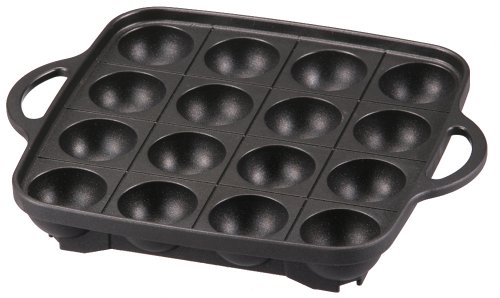
Otafuku's cast iron takoyaki plate has 16 holes for ball-shaped snacks and works on gas, electric, ceramic, and halogen stovetops.
Key Facts
- Capacity
- 16 holes
- Dimensions
- 9 x 9.25 x 1.25 inches
- Weight
- 3.5 pounds
- Material
- Cast iron
Pros
- +16-hole grid cooks multiple ball-shaped snacks at once
- +Cast iron construction for even heating and heat retention
- +Two handles for secure lifting and turning
- +Silicon coated surface for easier cleanup
Cons
- −Not induction compatible, limiting use on induction cooktops
- −Hand-wash likely needed to protect the silicon coating
- −3.5-pound plate needs dedicated storage space
Detailed Review
The 16-hole grid on this Otafuku plate is the detail that matters most. It lets you cook a full batch of takoyaki at once, and the same wells work for Danish aebleskiver or Indian paniyaram if you want to branch out. The cast iron body is built for even heating and heat retention, which suits the gradual turning that takoyaki needs.
I'd consider this for gas, electric, ceramic, and halogen stovetops, since those are the ranges Otafuku lists. The two handles make it easier to lift a 3.5-pound plate safely, and the silicon coated surface is meant to simplify cleanup. A takoyaki recipe comes with each order, which helps if you are new to the method.
The main trade-off is stovetop compatibility. Induction ranges are not listed, so check your cooktop before buying. The plate also measures 9 by 9.25 inches and weighs 3.5 pounds, so it needs a dedicated spot in a cupboard. I rate this a reasonable pick for anyone with a gas or electric range who wants to make takoyaki at home.
Tramontina's 12-hole appam pan is made of pre-seasoned cast iron and includes a tempered glass lid with silicone rim.
Key Facts
- Size
- 12-Hole
- Dimensions
- 13.94 x 10.5 x 3.06 inches
- Material
- Cast iron with stone-ground pre-seasoned interior
- Oven-Safe
- 450°F without lid, 350°F with lid
Pros
- +Twelve cavities speed up batch cooking for family breakfasts
- +Pre-seasoned cast iron improves release with repeated use
- +Tempered glass lid lets you monitor cooking without lifting
- +Silicone sleeves rated to 450°F for safe stovetop handling
Cons
- −Hand-wash only to protect the cast iron seasoning
- −Lid limits oven use to 350°F versus 450°F without it
- −Heavy cast iron construction makes lifting and storage harder
Detailed Review
The Tramontina Utsava appam pan is built around twelve cast iron cavities, a format that suits anyone cooking appam, paniyaram, or takoyaki for a family rather than a single serving. The stone-ground, pre-seasoned interior is the detail I'd weigh most, because a polished surface on cast iron tends to release batter more cleanly from the first use and keeps improving as the seasoning builds.
I see the tempered glass lid and silicone handle sleeves as practical additions rather than decoration. The lid's silicone rim helps hold heat between batches, and the sleeves make the heavy pan easier to maneuver on the stovetop. Worth knowing before you buy, the pan is hand-wash only and the lid drops the oven-safe ceiling from 450°F to 350°F, so it is not a set-and-forget piece for high-heat roasting.
For my money, this suits cooks who already keep cast iron and want a dedicated appam pan that earns its cabinet space through volume, not versatility alone.
Yardwe's cast iron takoyaki pan has 15 holes and comes with forks and a brush, sized at about 10.4 by 8.7 inches for home or restaurant use.
Key Facts
- Size
- 10.4 x 8.7 x 0.8 in
- Material
- Cast iron
- Holes
- 15
- Included
- Forks and brush
Pros
- +Cast iron construction for even heat distribution
- +15 holes suit takoyaki, meatballs, and escargot
- +Included forks and brush for turning and cleanup
- +Compact size stores easily in small kitchens
Cons
- −Cast iron requires seasoning and hand washing
- −No stated oven-safe temperature or induction compatibility
- −Single-purpose pan with limited everyday use
Detailed Review
Yardwe's takoyaki pan is built from cast iron with 15 round holes, and it ships with a pair of forks and a brush for turning and cleaning. At roughly 10.4 by 8.7 inches, the footprint is small enough to sit on a crowded counter or store in a cabinet without displacing much else.
I see this working best for anyone who makes takoyaki, meatballs, or escargot at home and wants a dedicated pan rather than a multi-purpose skillet. The cast iron body is designed for even heat distribution, which matters when you need consistent browning across all 15 wells at once.
Worth knowing before you buy is that cast iron needs seasoning and hand washing to keep its surface in shape, and the listing does not state an oven-safe temperature or induction compatibility. For my money, this suits a home cook with a specific use case rather than someone seeking an everyday pan.
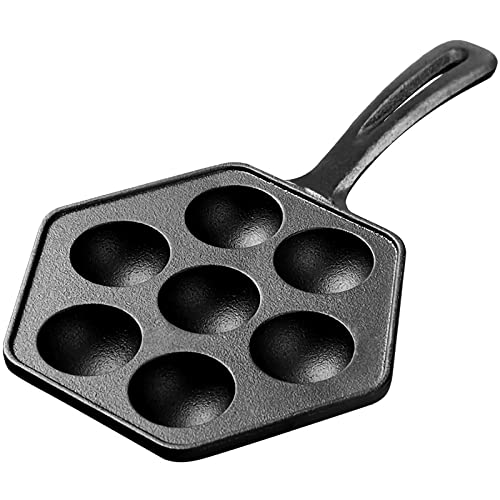
WUWEOT's cast iron aebleskiver pan measures 6.8 inches with seven 1.9-inch half-sphere cups and a scratch-resistant coating for easy hand washing.
Key Facts
- Diameter
- 6.8 in
- Cup Size
- 1.9 in diameter, 0.75 in deep
- Weight
- 2.8 lb
- Material
- Cast iron with scratch-resistant coating
Pros
- +Seven 1.9-inch cups for uniform bite-sized cooking
- +Cast iron build works across gas, induction, oven, and campfire
- +Scratch-resistant coating simplifies hand washing
- +Compact 6.8-inch diameter stores easily in small kitchens
Cons
- −Hand-wash only to preserve the nonstick coating
- −No stated oven-safe temperature limit
Detailed Review
The WUWEOT pan measures 6.8 inches across with seven half-sphere cups, each 1.9 inches wide and 0.75 inches deep, which sets the size of every takoyaki or aebleskiver ball you turn out. I'd consider this for anyone who wants a dedicated stuffed-pancake pan without giving up much cabinet space, since the 2.8-pound cast iron body is compact enough for a small kitchen drawer or shelf.
Cast iron construction is the real story here, because it works on gas, electric, induction, oven, broiler, grill, and even a campfire, so the same pan can move from a stovetop to a backyard fire pit. The scratch-resistant coating is a practical addition for sticky batters, though the listing recommends hand washing and drying immediately to keep that surface working.
Worth knowing before you buy, the listing gives no oven-safe temperature rating, so I would not push it past the manufacturer's stated instructions. For my money, this suits cooks making small batches of poffertjes, kanom krok, or filled pancake puffs who want cast iron heat retention in a compact pan.
A compact 7.5-inch uncoated cast iron pan with 12 wells for takoyaki, aebleskiver, and pancake balls, plus two picks and an oil brush.
Key Facts
- Size
- 7.48 x 7.48 in body, 11.81 in total length
- Wells
- 12 wells, about 1.5 in across
- Material
- Uncoated cast iron
- Care
- Dry over low heat and oil after washing
Pros
- +Compact 7.5-inch body stores easily in small kitchens
- +Uncoated cast iron with no synthetic nonstick coating
- +Twelve 1.5-inch wells suit takoyaki and aebleskiver batches
- +Turning picks and oil brush included in the box
Cons
- −Requires full drying and oiling after every wash
- −No stated oven-safe temperature or induction compatibility
- −Small wells limit output for larger households
Detailed Review
The Anxingo pan measures 7.48 inches across the body, with an 11.81-inch total length once the handle is counted, so it sits on a small burner without crowding a compact counter. Each of the twelve wells is about 1.5 inches across, which is the right size for takoyaki, aebleskiver, and mini pancake balls rather than full-size muffins.
Because the surface is uncoated cast iron with no synthetic nonstick layer, the pan needs a gradual low-to-medium preheat, an oiled well before batter goes in, and a full dry-and-oil routine after washing. I'd consider this a reasonable pick for someone who already keeps cast iron and accepts that maintenance as part of the deal.
Worth knowing before you buy, the listing gives no oven-safe temperature and no induction claim, so stovetop use is the safe assumption. The included two turning picks and oil brush cover the basics, but the small wells mean limited output for a larger household.
Iwatani Takoyaki Grill Pan, medium, 10.2 by 8.2 inches, with non-stick coated aluminum alloy and thick heat-retaining body.
Key Facts
- Dimensions
- 10.2 x 8.2 x 1.5 inches
- Weight
- 1.61 pounds
- Material
- Aluminum alloy with non-stick coated upper surface
- Size
- Medium
Pros
- +Non-stick coating simplifies takoyaki release and cleanup
- +Thick aluminum stores heat for consistent cooking
- +Compact footprint suits small kitchens and butane stoves
Cons
- −Compatible only with Iwatani cassette-feu butane stoves
- −Hand-wash care likely needed to protect non-stick coating
Detailed Review
The Iwatani Takoyaki Grill Pan is built around a non-stick coated aluminum alloy body that measures 10.2 by 8.2 inches and weighs about 1.6 pounds. That light weight matters because you lift and rotate the pan over a butane stove while filling takoyaki wells, and the coating is there to release batter without tearing.
The thick aluminum construction is the detail I keep coming back to, since it stores heat rather than dumping it all at once, which helps the centers set before the outsides scorch. I see this working best for someone cooking takoyaki at the table on an Iwatani cassette-feu stove, where the pan was designed to sit.
Worth knowing before you buy, the pan is sized for that stove system and not for a standard gas or induction burner, and the non-stick surface calls for hand washing to protect the coating. I rate it a reasonable pick for dedicated takoyaki nights, not a general grill pan.
FAQs
Can you use a cast iron takoyaki pan on a glass-top stove?
Cast iron takoyaki pans with a flat base work on gas, electric, ceramic, and halogen stovetops, but the pan’s own listing is the final word on compatibility. Glass-top ranges are sensitive to dragging heavy cookware, so lift rather than slide the pan when turning it. Check your stove manual before using any cast iron on a glass surface.
How many takoyaki balls should a pan hold for a family?
A 12 to 16 cavity pan suits most households because takoyaki cooks in batches of three to five minutes. Fewer cavities mean more rounds at the stove, which is fine for two people but slow for a crowd. If you regularly cook for four or more, lean toward the larger cavity count.
Do you need to season a cast iron takoyaki pan before first use?
Uncoated cast iron pans benefit from a wash, a full dry, and a thin coat of oil before the first cook. Pre-seasoned models skip most of that step but still reward a light oiling in each well. Follow the manufacturer’s seasoning instructions for your specific pan, since coatings and finishes vary.
Is a nonstick takoyaki pan easier to clean than bare cast iron?
A coated pan wipes clean with less scrubbing, while bare cast iron needs drying over low heat and a re-oil after every wash. The trade-off is longevity: coatings can wear with harsh scrubbing, and cast iron improves with use. For a comparison of how cast iron care differs across cookware types, the cast iron teapots guide covers similar seasoning and storage habits.
Final Thoughts
What matters most in a takoyaki pan is even heat across the cavities, a base that sits flat on your stove, and a finish you are willing to maintain. Cavity count and handle design decide how comfortably the pan fits your household and your turning technique.
For most kitchens, the Otafuku Takoyaki Plate, Cast Iron Japanese Grill is the best overall choice. Its 16 cavities handle a family batch in one go, and the cast iron body is built to hold heat through repeated rounds. The two handles make it easier to rotate the pan when one side of the stovetop runs hotter than the other.
If you want a lower-cost entry point, the WUWEOT Nonstick Aebleskiver Pan is the best value pick. It is compact enough for small kitchens and works for takoyaki, aebleskiver, and other batter-based bites, so it earns its space even if takoyaki is only an occasional project. Either way, the right pan removes the guesswork about whether your batter will release cleanly.